 Potentate
Memorise the verse. Know where it comes from.
A few minutes a day, with each verse coming back just before you would forget it. Every card carries the setting it was written in.
Say it from memory, then check.
Read the reference
Each card shows only the reference. Say the verse aloud or in your head.
Turn the card
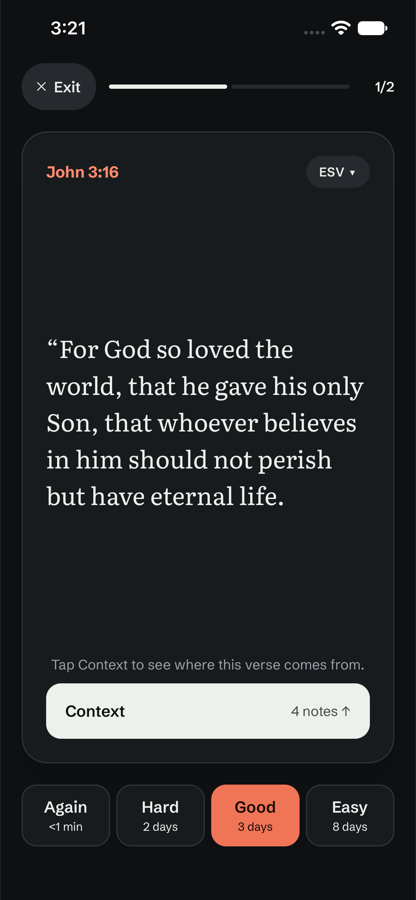
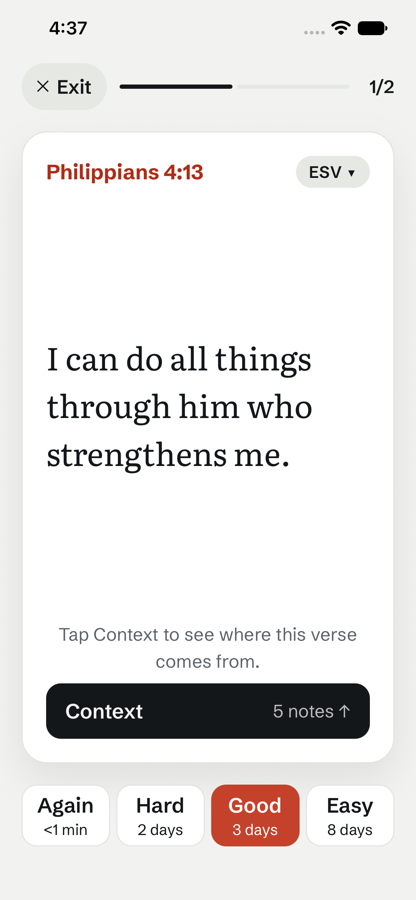
See the verse, then rate how well you knew it: Again, Hard, Good or Easy.
See it again later
Verses you know come back less often. Ones you find hard come back sooner.
The verse, in its setting.
Many verses are quoted without the page they sit on. Each card has short notes on where it comes from, so you learn it the way it was meant.
Philippians 4:13
Say it from memory, then tap the card.
I can do all things through Christ which strengtheneth me.
Tap Context on that card and you get this:
Philippians 4:13
Setting
Paul wrote this from prison, probably in Rome around AD 60–62, to thank the church at Philippi in Greece for a gift (4:10, 18). Roman prisoners usually relied on friends for food, so hunger was a real threat and their gift mattered.
Surrounding passage
Just before, Paul says he has learned to be content with plenty or with hunger (4:11–12). Just after, he thanks them for sharing his trouble and promises God will supply all they need (4:14, 19).
Key words
In context, the situations Paul has just named: plenty and hunger, having much and having little.
The strength is Christ’s, not Paul’s own, and it keeps coming: enough to be content in any situation.
Commonly misused
Used as a slogan for winning games or reaching any goal you set.
Using it rightly
This is what Paul learned: Christ gives strength to be content whether full or hungry, rich or poor. That is what his “all” covers. Lean on it in hardship and in plenty alike, not as a promise you’ll win whatever you attempt.
Every card has notes like these. The notes are written for Potentate, not taken from a study Bible.
Quiet by design.
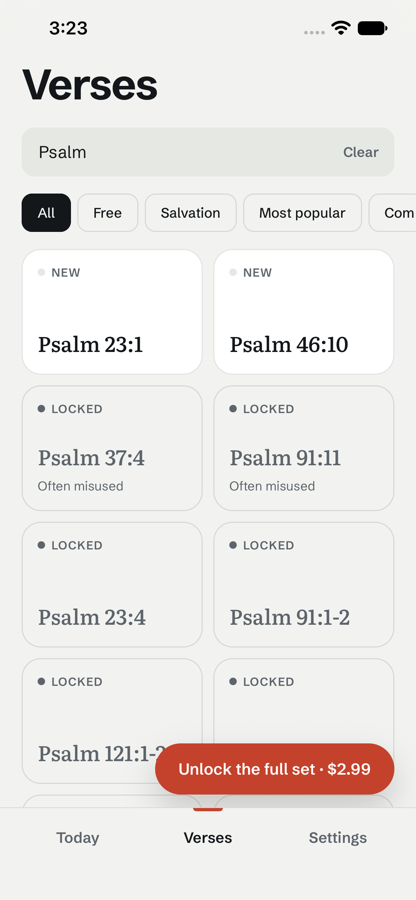
Plain grey, one red accent, and the verse set in a serif with room to breathe. Light and dark.
Plain terms.
Free to start
Begin with a set of verses at no cost.
One purchase
A one-time unlock for the rest. No subscription.
No account
No sign-in and no ads.
Private
Your progress stays on your phone.
Questions
Why the name Potentate?
It comes from 1 Timothy 6:15, where the KJV calls God “the blessed and only Potentate, the King of kings, and Lord of lords.”
Do I need an account?
No. Open the app and start. Your progress stays on your phone.
Which translations are included?
ESV, KJV, NASB, NIV and NLT. You can switch on any card, and choose your default in Settings.
Is it on Android?
Not yet. It is on iPhone first.
Are the context notes from a study Bible?
No. They are written for Potentate.
Follow along.
Verses in context, new cards and updates.